 Written by
 | Story | |
| Gameplay | |
| Graphics | |
| Audio | |
| Polish | |
| Replayability | |
|
Average
|
|
I first played the original .hack//G.U. trilogy years ago on PS2, back when the idea of a single-player game that pretended to be an MMO still felt novel. I was deep into the series lore, the message boards, the weird little in-game news articles, all of it. Not least of all because I had already become enamored with the franchise through the original IMOQ quadrilogy and anime like .hack//Sign. When Last Recode came out I bought it, started Rebirth, and then… life happened. It sat unfinished for a long time.
Coming back to it now feels strange in a good way. The game hasn’t changed, but I have. What used to feel cutting-edge now feels like a time capsule of mid-2000s online culture, complete with all the awkwardness and charm that comes with it. This isn’t a fresh hot take. It’s me looking back at the first volume with clearer eyes and deciding where it still holds up.
Story – 3.5
Rebirth does a solid job of setting up Haseo’s fall and the larger mystery around Tri-Edge and the Epitaph users, but it takes its time getting there. A lot of the runtime is spent on the tournament structure and introducing the supporting cast, and in many ways, these couple of aspects feel like the goodliest portion of Volume 1’s story. The writing can be melodramatic in that classic .hack way, and some of the emotional beats land harder if you’re already invested in the series. For a first volume it’s serviceable and occasionally strong, especially once the Avatar battles start mattering, but it never quite escapes feeling like setup. Volume 1 feels, in most ways, like Act 1 of a larger story. Which, I suppose, is exactly what it’s meant to be.
Gameplay – 3
The combat is where the game shows its age the most. It’s functional real-time action with some interesting systems (Rengeki, Awakenings, the morale gauge), but it never becomes truly satisfying. Dungeons are still mostly corridors with the occasional gimmick, and the level-scaling can make fights feel either trivial or artificially difficult. It’s not broken, but it’s rarely exciting. You play it because you want to see what happens next, not because the moment-to-moment action is pulling you forward.
The systems that support gameplay, such as skills, weapons and other equipment, elemental affinities, support items, guild features, etc. are robust, but not overwhelming. They’re well thought out, but the combat in Volume 1 renders most of these systems moot. For most playthroughs, the average player can largely ignore buffs and elements and other strategic aspects in favor of just equipping the highest level weapon you can and button mashing until everything is dead.
Where the gameplay really shines is in novel mechanical concepts. The Area Word system is a perfect example. Choosing and combining keywords to generate fields and dungeons still feels clever and unique, giving exploration a sense of deliberate selection rather than just picking a level from a list. Combined with the in-game mail, forums, news boards, player events, and the constant background chatter of other “players,” the game does an excellent job of selling the fantasy that you’re logged into a living online world. Even when the combat itself is middling, that layered simulation of MMO culture is what keeps the experience distinctive and, for a lot of people (and me in particular), more memorable than the actual fighting.
Graphics – 3.5
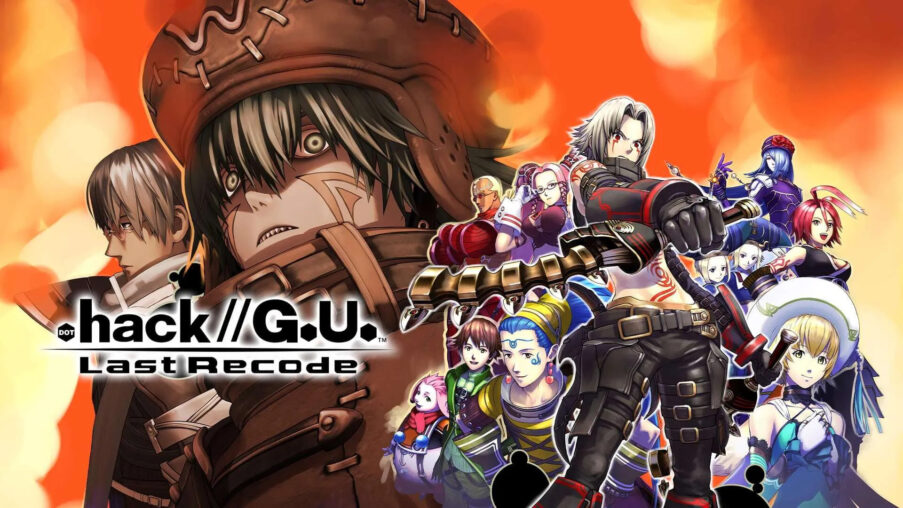
For a remaster of a PS2 game, .hack//G.U. looks decent. Character models hold up better than the environments, and the UI still has that distinctive mid-2000s digital aesthetic that somehow fits the setting. It’s not going to impress anyone in 2026, but it has a consistent visual identity and doesn’t look broken.
Audio – 4
This is one of the strongest parts of the package. The soundtrack is excellent. It’s atmospheric when it needs to be, dramatic when the story calls for it, and full of tracks that still hold up on their own. Voice acting is a mixed bag where some of the delivery is very “early 2000s anime dub” (looking at you, Yuri Lowenthal), but the music carries a lot of the emotional weight and does it well. The sound design in general is also spectacular, and I still get chills every time I hear a tuning fork.
Polish – 3
There’s a certain clunkiness that never quite goes away. Menus, camera, the way some systems are explained (or not explained), the occasional rough edge in the presentation. It’s clear this was a PS2 game that received a competent but not transformative remaster. Nothing is outright broken, but you can feel the limitations and the age in the small details. In defense of the developers, most of the lack of polish is down to holding G.U. up against contemporary quality of life sensibilities.
Replayability – 4.5
This is where Rebirth (and the G.U. trilogy in general) still shines. Multiple party members with their own story scenes, optional content, the desire to see different character interactions, and the knowledge that the full picture only comes together across all three volumes. For fans of the series, or anyone who gets invested in the world and the cast, there’s real reason to come back and dig deeper. The first volume alone already plants enough hooks that you want to keep going.
Overall it still feels like a game that knows exactly what it wants to be, even when some of its systems haven’t aged perfectly. The atmosphere, the music, and the strange charm of its fake-MMO world are what keep it interesting more than a decade later.
Want to rate this game yourself? Cast your vote below!
| Story | |
| Gameplay | |
| Graphics | |
| Audio | |
| Polish | |
| Replayability | |
|
Average
|
|

|
|